
(33 Reviews)
My book “SAM’S BULLET” explained who was responsible for igniting World War I—a conflict that killed some forty million people. Tragically, the world descended into madness again only twenty-two years after the final bullet of the first war was fired.
The “War to End All Wars,” as it was naively labeled, ended in 1918. After a brief interlude—just long enough for Germany to regroup and regain strength—the world watched chaos erupt once more. As before, the author argues, it was the “bloody-minded Germans” who plunged humanity back into the abyss. This time, there was no assassination, no spark—nothing. The book asserts that responsibility for World War II lies solely with one man.
Born on April 20, 1889, Adolf Hitler survived infancy and grew up in Austria as a struggling, poorly educated artist. When World War I began, he was drafted but rejected for medical reasons. Undeterred, he requested permission to enlist in the German Army, which proved less particular.
Assigned to the 16th Bavarian Reserve Infantry Regiment, Hitler found himself in France by October 1914. He survived the First Battle of Ypres—tragically, for the world—and earned the Iron Cross for rescuing a wounded comrade. As a dispatch runner, he served in extraordinarily dangerous conditions. On October 14, 1918, at Ypres Salient, he was temporarily blinded by a British gas shell and evacuated to Pasewalk in Pomerania.
During the war, Hitler participated in multiple major battles, including Neuve Chapelle, the Second Battle of Ypres, and the horrific Battle of the Somme. On October 7, 1916, he was wounded in the leg near Bapaume, France. Sent to convalesce, he survived what might have been a fatal infection and returned in February 1917.
According to fellow soldier Hans Mend, Hitler frequently erupted into rants about morale and treachery within Germany:
“He sat in the corner… Suddenly, he would leap up, running about, spitting and frothing, saying that in spite of our big guns victory would be denied because the invisible foes in the German Government were a greater danger than the biggest cannon of the enemy.”
He earned further commendations, including an Iron Cross 1st Class for bravery. In August 1918, during the final German offensive, he captured a group of French soldiers single-handedly. His 1916 injury eventually ended his military service, though not his ambition.
Hitler learned of Germany’s surrender while recuperating. Furious and emotionally shattered, he later wrote in Mein Kampf:
“I staggered and stumbled back to my ward and buried my aching head between the blankets and pillow.”
Believing that Germany had been betrayed by its government, Hitler built the ideological foundation of National Socialism from his wartime experiences. In 1941 he declared:
“I brought back home with me my experiences at the front; out of them I built my National Socialist community.”
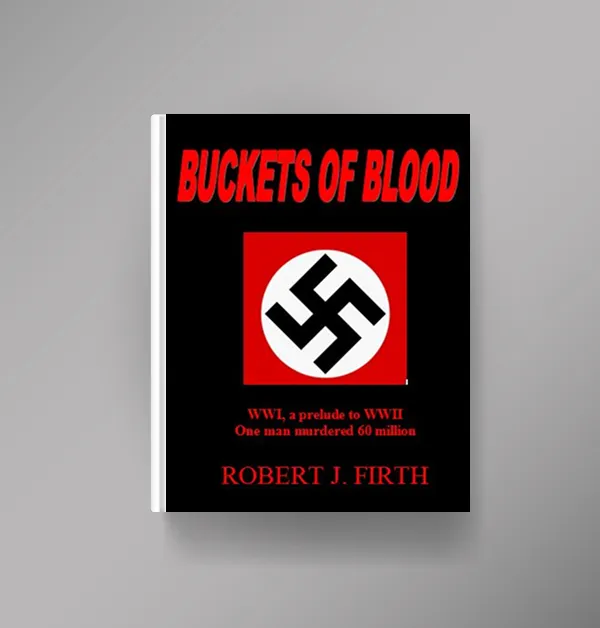
This book argues that Hitler alone was capable of motivating Germany to ignite World War II. Thus, the author places responsibility for sixty million deaths squarely on one individual. Had he never been born—or had he died during the war, or been executed after his failed 1923 coup—the second world war likely never would have occurred.
Hitler survived 32 assassination attempts. Had even one succeeded early, millions of lives might have been spared.
In this volume, the author attempts to make sense of evil while examining history’s cast of characters—actors on a stage full of sound and fury, signifying little except misery and murder.
A surprise awaits in the appendices: a purportedly declassified top-secret document of Hitler speaking privately to his only personal confidant. The author cannot verify its authenticity, leaving the reader to decide.
Robert J. Firth
Florida, 2019