(15 Reviews)
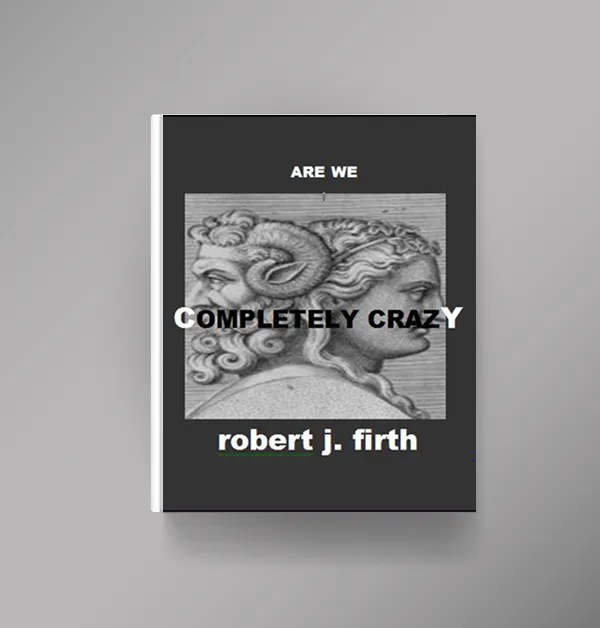
An inquiry into the nature and mind of mankind asking: Are We Completely Crazy?
A story about the gentle arts as opposed to the art of killing… if such can even be called “art.”
The dictionary defines crazy as mentally deranged, demented, insane, senseless, impractical, and totally unsound. The central question we ask in this book is—are we an insane and doomed species? That question has tormented thinkers for centuries. It keeps resurfacing like a message floating up in a dark glass ball, answering every man’s questions.
We examine the enormous quantity of wealth and intelligence expended in the “business” of killing compared with the same qualities invested in saving lives and making the world a better place. Physicians, medical professionals, artists, musicians, builders, designers—these are people who improve civilization. On the other side are those who dedicate their lives to designing and using bombs, tanks, bioweapons, and WMDs.
If philosophers can agree that saving lives is a moral good while taking life is not, then the former is “good” while the latter is clearly “bad.” Perhaps this offers a simple argument that “good” and “bad” truly exist and are not merely subjective constructs of political correctness. The skills required for saving life far exceed those for taking life—this point can hardly be argued.
The money spent designing, building, and deploying weapons may equal the cost of all medical advancements. But here is the difference: government funds the tools of killing, while private enterprise largely drives medical innovation. What does this say about the nature of government compared to the healing arts?
Can a government that funds weapons of destruction be anything but morally compromised?
MEDICAL ARTS THROUGH THE AGES**
"It is open to a war resister to judge between the combatants and wish success to the one who has justice on his side. By so judging he is more likely to bring peace between the two than by remaining a mere spectator."
— Mahatma Gandhi
Many extraordinary individuals devote years of arduous study to learn the healing arts. They live in a world far removed from the dark underbelly of humanity—where others plot destruction and perfect the mechanisms of war. To me, those in the medical arts represent the epitome of sanity in a world seemingly gone crazy.
Others pursue music, painting, the fine arts, writing, architecture, construction, or—as I did as a pilot—the field of transportation. These fields aim to improve civilization, not destroy it.
Before we begin, refer to the appendices, where we list companies manufacturing military hardware versus those producing medical devices. There are 19 pages of medical manufacturers and only 6 pages of weapons producers. Does this suggest humanity is not as crazy as we fear? Perhaps yes, perhaps no. Read on and decide for yourself.
This book attempts to understand this grand dichotomy—to contribute to the field of human ethics by contrasting the ethos of medicine with the mindset of those who practice the art of killing. We also explore a particularly dark moment in American history: the perceived destruction of the medical profession through government intrusion under the Affordable Care Act.
Has postmodern “liberal” culture warped the terrain of medical care? Has moral confusion overtaken ethical clarity? Have bureaucratic failures—such as those in the Obama-era VA—become the norm? Have we grown so apathetic that thousands of premature deaths move us no more than a shrug?
This inquiry into the ethos of medicine in the postmodern era examines the cultural and political forces shaping our decline: socialism, Marxism, entitlement culture, consumerism, computerization, corporatization, the erosion of privacy, and the loss of compassion.
Any attempt to explore the “hidden core” of the human soul must consider the insights of history’s greatest minds. We stand on their shoulders. Cultural thinkers such as Adorno, Foucault, Deleuze and Guattari, Lyotard, Baudrillard, Bauman, and Levinas each offer perspectives on the transformation of healthcare in the twenty-first century. (Brief descriptions appear in the appendices.)
And as a shocking example of government-run healthcare gone awry, the book cites a revelation from the English National Health Service: public hospitals were reportedly heated by burning the fetuses of aborted humans. (Appendices provide the referenced evidence.)
This—if true—forces us to confront a chilling question:
Are we completely crazy?